
Frequently asked questions
Max Zorn & original tape art
How the art is made, where it has travelled and what it means to own an original. Explore the stories, exhibitions and practical details behind Max Zorn’s tape art.
Max Zorn & the art
The artist, the atmosphere and the Amsterdam beginnings.
Who is Max Zorn?
Max Zorn is an Amsterdam-based contemporary artist known for creating detailed portraits and cinematic scenes from ordinary packing tape. He cuts and layers the tape by hand on acrylic glass, using light from behind to reveal the image.
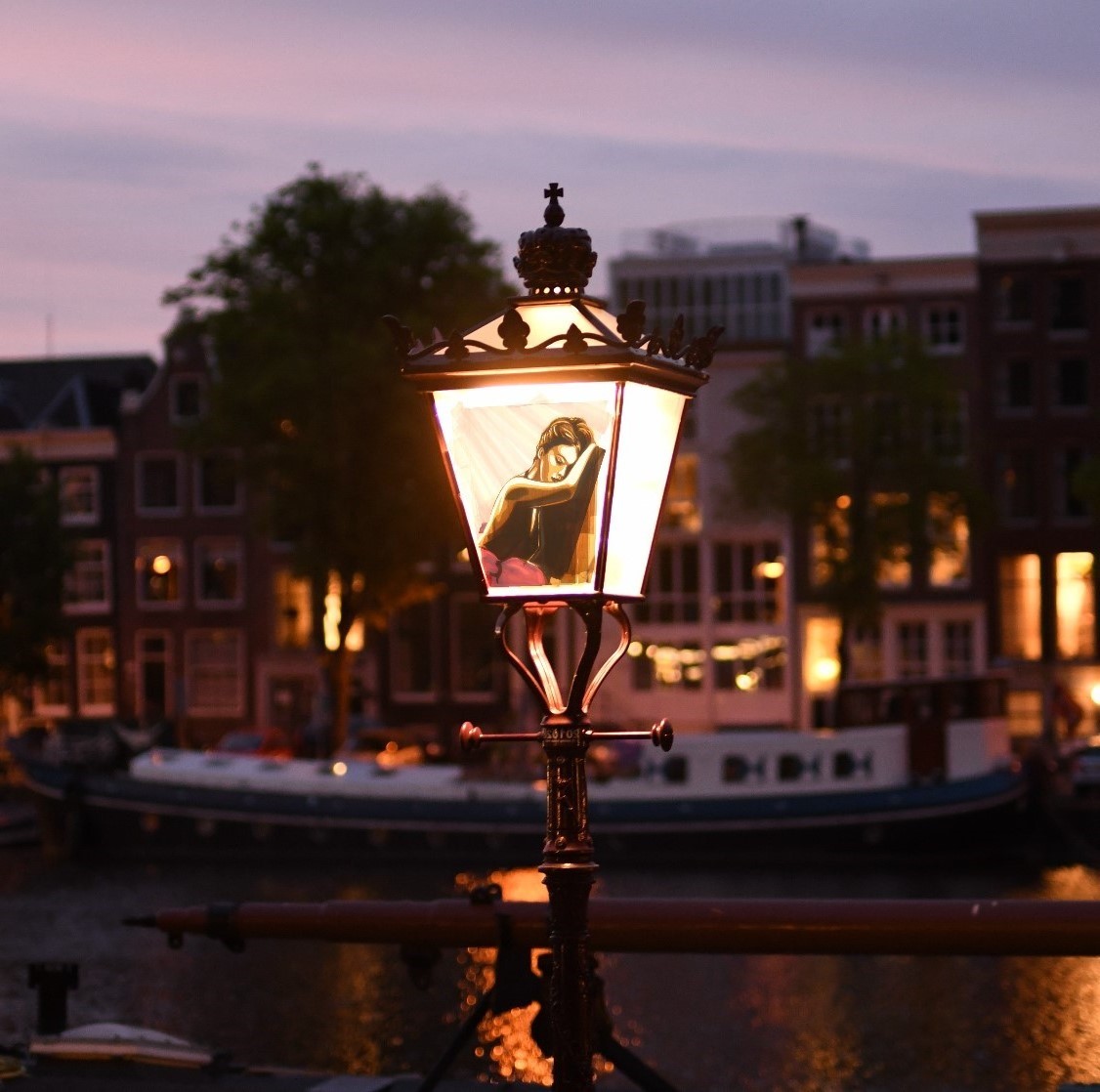
His art first appeared on Amsterdam’s street lamps in 2011. Since then, it has travelled to international art fairs, museum exhibitions and collections, with features by BBC News, CNN, CBS Sunday Morning and Deutsche Welle. His museum history includes MUCA in Munich, the Dutch Resistance Museum in Amsterdam and Hill-Stead Museum in Connecticut. Explore the exhibition history.
What is tape art, and what kind of artist is Max Zorn?
Tape art uses adhesive tape as an artistic medium. It includes several approaches, from graphic wall installations to intricate images. Max Zorn is particularly known for figurative packing-tape art: the tape itself supplies the colour, shading and detail.
His practice connects contemporary art, street art, urban art and light art. Those descriptions each reveal something different: the images, their public beginnings, their relationship with the city and the illumination that makes them visible. Read about tape art and its development.
What makes Max Zorn’s tape art distinctive to collect?
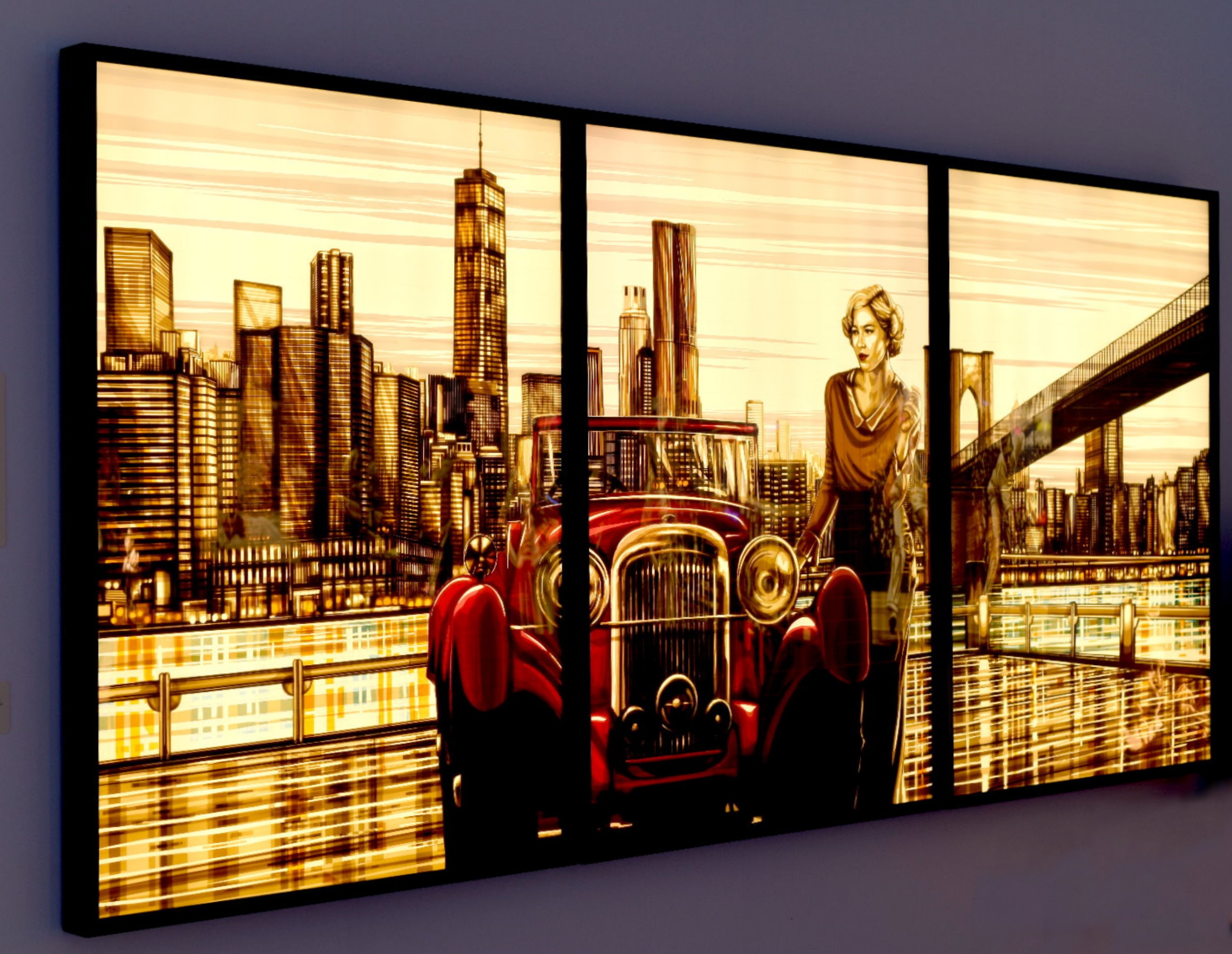
The attraction often begins with the scene: a late-night diner, a jazz musician, a rain-soaked city or two people whose story is left unresolved. Up close, the familiar picture becomes something unexpected—a physical construction of overlapping, hand-cut tape.
That combination of narrative imagery, demanding handwork and illumination gives a Max Zorn artwork a presence of its own. There is also a substantial career to explore: museum exhibitions, international criticism and a public auction history. Start with the artworks and follow the image that holds your attention.
What subjects and moods appear in Max Zorn’s artworks?
Classic cars, beautiful women, crowded cities and private encounters recur in Max Zorn’s original tape art, alongside travel, sunlight and fantasy. The illustrated artwork guide follows these differences through eleven works, with interviews and criticism. They are examples of his oeuvre; the newsletter introduces future artworks and opportunities to collect.
Are the artworks based on films, photographs or real places?
Max’s compositions bring together references, remembered impressions and invented settings. They can have the atmosphere of a film still without illustrating an existing film. A recognisable building or vintage car can sit inside a scene that is otherwise fictional.
In his Widewalls interview, Max describes nostalgia as a way of telling stories and leaves room for viewers to bring their own experiences to the picture. The Financial Times review captured the atmosphere with the phrase “Hollywood-noir glamour.”
How did Max Zorn come up with the idea?
Amsterdam’s street lamps offered Max an exhibition space that was already lit. In early experiments, he added brown packing tape to drawings on acrylic glass. Held against the light, the layered tape produced depth and shading that led him to leave the marker behind and build complete images from tape.
Those small nighttime interventions became the beginning of a much larger practice. The street-art archive shows the work in the setting where it first found an audience.
What is the Stick Together street-art project?
Stick Together began as an invitation to help place art in public. Max gave people small handmade tape artworks to install on illuminated urban surfaces, then asked them to share photographs and stories of the results. Participants chose the places and became part of the project.
It carried the work beyond Amsterdam through individual encounters rather than a single exhibition venue. Max discusses that participatory beginning in his TED@Amsterdam talk and in international interviews.
Making original tape art
Packing tape, a scalpel, acrylic glass—and a great deal of work by hand.
How does Max Zorn create his tape art?
Max builds the image by applying layers of translucent packing tape to acrylic glass and cutting them with a scalpel or X-Acto knife. More layers make an area darker; fewer layers let more light through. Small changes in the cut edges and the number of layers create faces, fabric, reflections and architectural detail.
The finished artwork is an arrangement of physical tape, made by hand. The film below shows that process in action. Explore the tape-art technique.
Does Max Zorn use paint, or is the colour really tape?
The images are made from tape. Brown packing tape produces the warm tonal range familiar from many of Max’s artworks; coloured tape brings additional colours into other compositions. The colour is built into the layers rather than painted onto a finished print.
Why is light essential to the artwork?
Light passes through the tape and reveals the differences between its layers. It is what makes a dark silhouette, a reflected headlight or a face emerge from the material. The effect has something in common with stained glass, although the image is constructed from tape on acrylic glass.
Street lamps supplied that illumination for the early public artworks. Collector pieces are presented in custom LED lightboxes, giving the artwork a consistent light source indoors.
How long does it take to make an original tape artwork?
The time depends on the size, composition and level of detail. Every physical original has to be cut and layered by hand, including pieces made within a Similar Originals series. Developing a new composition adds another stage before that handwork begins.
Large projects can take months: Max’s roughly ten-by-five-foot triptych Let Them Have the Rest took more than two months to make. Production time is one reason a confirmed purchase may involve a wait.
Does Max Zorn make large artworks as well as smaller pieces?
Yes. His practice ranges from small portraits and intimate scenes to large cityscapes and multi-panel installations. Some artworks use vintage cigar boxes or reclaimed wooden crates as frames; others are presented in purpose-built lightboxes or ambitious formats such as triptychs.
For a particular wall or interior, send the dimensions and the artworks that interest you to buy@maxzorn.com. The team can explain the formats currently available.
Watch an artwork take shape
Exhibitions, collections & recognition
Museums, international art fairs, collections and critical writing.
Which museums have exhibited Max Zorn’s art?
Max Zorn’s museum history spans solo exhibitions, group shows and installations in very different settings:
- MUCA, Munich — the solo exhibition City Lights – Tape Art Max Zorn, 2022–2023.
- Dutch Resistance Museum, Amsterdam — Children of the War, an illuminated portrait installation during Amsterdam Light Festival, 2013–2014.
- Amsterdam Museum — My Time, My Town, presented for Museumnacht in 2014.
- Cornell Art Museum, Delray Beach — Reimagined, a 2015 group exhibition devoted to unexpected materials.
- Hill-Stead Museum, Connecticut — artwork from the Arethusa Collection, exhibited in 2024–2025.
His exhibition record also includes Eye Filmmuseum in Amsterdam. The full exhibition archive brings these museum appearances together with galleries, festivals and international art fairs.
Is Max Zorn’s art held in recognised collections?
Yes. Ripley’s Believe It or Not! acquired a Marilyn Monroe tape artwork, and Max’s art forms part of the collection at Bowie House in Fort Worth, featured by Forbes. His work in Tony Yurgaitis’s Arethusa Collection was presented at Hill-Stead Museum.
Explore the Ripley’s record, Bowie House presentation and Arethusa Collection exhibition for the artworks and their settings.
At which international art fairs has Max Zorn shown his work?
His exhibition history includes SCOPE Miami Beach, Aqua Art Miami, CONTEXT Art Miami, Moniker in London, Affordable Art Fair Hong Kong and District 13 Art Fair in Paris, alongside presentations in cities across Europe, Asia and the United States.
For 2026, Max is presenting new tape artworks with The Sykes Gallery at Art Miami, 1–6 December, during Miami Art Week. See upcoming events and the complete fair history.
Which broadcasters and publications have featured Max Zorn?
Television features include BBC News, CNN Style, CBS Sunday Morning, Deutsche Welle’s Euromaxx and NBC Texas Today. Written coverage includes the Financial Times, Artsy, Widewalls, Huffington Post, Forbes, Süddeutsche Zeitung, La Vanguardia, La Repubblica and Art Business News.
The coverage follows different parts of the practice: making tape art, the street-art project, exhibitions, collecting and the stories behind the images. The International Media page brings together videos, interviews, articles and the earlier press archive.
What have art critics written about Max Zorn’s work?
Writing for Artsy, Anna Furman examined how Max transforms an everyday material into cinematic scenes, observing that “The value of Zorn’s work is inherent in his process”. Her article looks at the skill and construction behind the images.
Rachel Spence’s Financial Times review placed the work in the context of London’s Moniker fair and its film-noir atmosphere. These longer readings are a useful companion to the demonstrations on television: read the Artsy article or the Financial Times review.
Has Max Zorn given TED talks or created art live?
Max spoke at TED@Amsterdam in 2012. He and Audrey Sykes later presented Stick Up: The Layers of Tape Art at TEDxTUM in Munich in 2015. The talks connect the making of the artworks with the public participation behind Stick Together.
Live creation is also part of his exhibition practice, including a presentation at 3M’s Idea Exchange Lounge at SXSW in Austin. He also participated in the 3M Digital Art Show in Rio de Janeiro in 2015. As Max told Art Business News: “Art in the making is what fascinates me.” Explore the Amsterdam talk, the Munich talk and the SXSW presentation.
Has Max Zorn received awards for his art?
At Spectrum Miami in 2015, Max Zorn received Artist of the Year recognition, while Stick Together Gallery was named Best New Exhibitor of the Year. The presentation was also selected for Spectrum’s Spotlight programme. The Spectrum exhibition account records those distinctions.
Has Max Zorn’s art appeared in books?
Yes. The novel Lost by James Patterson and James O. Born names Max Zorn and describes his packing-tape artwork on an Amsterdam street lamp. It is an unusual appearance of a contemporary artist’s work inside a fictional scene.
Ripley’s also included his art in its illustrated annual. Read the context for the passage in Lost and explore the Ripley’s archive.
Does Max Zorn have a public auction record?
Yes. Max Zorn’s art has appeared at Tajan and Digard in Paris, Julien’s in Los Angeles, Chiswick in London and Heritage in Dallas, with documented auction sales spanning more than a decade.
The auction-results archive brings together named artworks, auction houses, dates and source links. When comparing results, check the size, date, series and whether the published amount includes the buyer’s premium. An auction result concerns that particular artwork and sale.
Collecting & availability
Originals, commissions and the annual Special Releases.
Can I buy an original Max Zorn artwork directly from the studio?
Yes. The Buy page explains the current routes to collecting: direct enquiries, available artworks and commissions, and the annual Special Releases. Artworks are also presented through galleries and international fairs.
If something in the gallery stays with you, send the title or image to buy@maxzorn.com. The team can tell you about that artwork’s status and relevant possibilities.
How do I enquire about an artwork or begin a purchase?
Email buy@maxzorn.com with the artwork title or a link, and your country of delivery. If you have a particular size, budget or date in mind, include that too. You do not need to know every technical detail before asking.
The team can confirm availability, the price, the format and the expected delivery time. For an annual release, follow the instructions on the Special Releases page when it opens.
How much does a Max Zorn artwork cost?
Prices depend on the artwork’s size, complexity, format and series. A small original in a vintage box and a large illuminated triptych involve very different amounts of work and presentation. Special Releases offer a selection of new artworks in different sizes and price ranges at introductory studio prices.
For a current price, consult an open offering or contact buy@maxzorn.com. Older sales remain in the archive; their prices do not indicate current availability. The collecting guide explains what a direct purchase includes.
What are Similar Originals? Are they prints?
Similar Originals are individually handmade tape artworks based on the same composition, within a defined series. Max makes every physical artwork anew: cutting and layering the tape by hand, then signing it. They are original tape artworks, not printed reproductions.
The composition remains recognisable, while the handwork produces small differences between examples. Each series has its own declared maximum. Read the full explanation of Similar Originals.
Why does Max create artworks in a series?
Developing a composition is a substantial part of the work. A limited series shares that development across several originals, making each artwork more accessible than if one collector had to carry the whole process. Max still makes every physical artwork himself.
Think of a stage performance: the same underlying piece can be performed again, but every performance is made afresh. A Similar Original still requires the full physical process of cutting and layering tape.
How can I check an artwork’s authenticity and series details?
Original Max Zorn tape artworks are handmade and signed. Check the title, dimensions, materials and, where applicable, the series number and declared series size against the accompanying documentation.
When buying through the studio, the team can explain the documentation for the particular artwork. For a resale or auction purchase, ask the seller for provenance and clear photographs of the artwork, signature and any certificate. Contact buy@maxzorn.com if you need help understanding the record.
What are Special Releases, previously known as Special Sales?
A Special Release is the exclusive online launch of Max Zorn’s new annual art collection, usually seven to ten new tape artworks developed over the year, in different sizes and price ranges. Long known as the Special Sales, these annual releases offer originals and special editions directly from the studio at introductory prices.
The annual collection often makes its physical debut around Miami Art Week. The next online release is scheduled for 12 December 2026 with opening time and participation details to be announced. See the upcoming release and past Special Sales.
How are artworks allocated when a release is oversubscribed?
Half the available pieces in each series will be allocated first come, first served; the other half by lottery.
The instructions for each release explain how to participate. Joining the newsletter keeps you connected to the studio, but does not reserve an artwork or guarantee selection. Follow the Special Releases page for the current release information.
Why can there be a waiting time of up to twelve months?
Demand can exceed the number of artworks Max can finish at once. A series is limited, but its individual originals are not necessarily all made in advance. Each one still has to be cut, layered, finished and prepared for display, alongside new compositions and exhibition commitments.
For some purchases, the wait can reach twelve months. The team will confirm the expected timing for the particular artwork, so collectors can decide with that information in hand.
Can I commission an artwork or discuss a particular space?
Commission enquiries are welcome. Send the subject or mood you have in mind, the available wall dimensions, a photograph of the setting and any timing considerations to buy@maxzorn.com.
The conversation starts with whether the idea suits Max’s art and current commitments. A commission can be an opportunity to develop a personal connection with the work; the scope, price and schedule are discussed for the individual project.
What is included in a direct studio purchase? Is worldwide shipping available?
For direct purchases from the studio, the price includes the artwork’s lightbox, worldwide shipping, taxes, tariffs and import handling. The team confirms the details for your artwork and destination as part of the purchase.
If you buy through another seller, check that seller’s terms. The Buy page is the main guide to collecting directly from Max Zorn’s studio.
Does Max Zorn also offer prints?
Yes. Print editions have their own shop at Max Zorn Prints. They are a separate format from original tape artworks and Similar Originals, which Max constructs by hand from layers of tape.
The print shop has its own newsletter, current selection and ordering details. Enquiries about original tape art belong with the studio’s collecting team.
What should I do if the artwork I like is sold out?
A sold-out series remains part of Max’s body of work, so its images and history stay in the archive. If it is a composition you particularly love, send the title or image to the team. They can explain its status and whether a relevant alternative or commission conversation is possible.
For new collections, join the newsletter through the Special Releases page so you stay connected to what Max is making next.
Living with the artwork
Light, installation and looking after original tape art.
How long does Max Zorn’s tape art last?
Max Zorn’s collector artworks are made for long-term indoor display. The tape image is protected by acrylic panels, and the lightbox provides controlled illumination from low-heat LEDs. Protective glazing and careful construction help shield the artwork from everyday handling and environmental exposure.
Care matters: avoid prolonged direct sunlight, strong heat and damp conditions. The light source and the tape artwork are separate components, so a lighting repair does not mean remaking the picture. The Tape Art Longevity & Preservation Guide explains the studio’s construction and care approach.
Can I hang the artwork in sunlight or outdoors?
Collector lightboxes are intended for indoor display. Choose a position away from prolonged direct sunlight, radiators and strong heat or moisture. UV-resistant glazing offers protection, but careful placement is still part of looking after the artwork.
The early street-lamp installations were made for a different setting. Their outdoor history is part of the art’s origins; a collector lightbox should be installed and cared for according to its own instructions.
How should I clean a tape artwork and its lightbox?
Clean only the exterior glazing and frame, following the care instructions supplied with the artwork. Use a soft, clean cloth and a cleaner suitable for the particular acrylic surface; avoid abrasive materials and household solvents.
Do not open the protected tape image or try to clean the tape itself. If you are unsure about a mark, the glazing or a frame, send a photograph to info@maxzorn.com before attempting a repair.
What does the artwork look like when the light is switched off?
Without backlighting, the layers of tape look much darker and the finer tonal differences are less apparent. Switching on the lightbox reveals the image’s depth and colour. Illumination is part of how Max composes the artwork, rather than an extra spotlight added afterwards.
Do the lightboxes run on batteries?
The standard lightboxes plug into a mains electrical outlet. A suitable adapter for the destination and an extension cable are supplied with a direct purchase. They are not rechargeable battery frames.
The power cable is thin and can be routed discreetly. If cable placement matters for your wall or interior, share a photograph with the team before installation so the layout can be discussed.
What happens if the lighting stops working?
The LED lighting and power adapter are replaceable components. A failed adapter or light source does not normally mean that anything is wrong with the tape image itself.
Contact info@maxzorn.com with the artwork details and a description of the problem. The team can help identify the component and advise on replacement. Avoid opening the protected image or attempting electrical modifications yourself.
Can the lightbox be left on for long periods?
The custom lightboxes use low-heat LEDs for regular indoor display. Follow the operating instructions supplied with the particular artwork and adapter, and keep the installation away from excess heat or moisture.
A timer can be useful if you want the artwork illuminated only during certain hours. The team can advise on the electrical setup for the specific lightbox.
Does illuminated tape art suit a home, office or hotel interior?
Yes. The combination of a figurative scene and its own light source can make the artwork a focal point in a living room, study, reception area or hospitality setting. A quiet portrait and a large cityscape create very different effects, so subject, scale and placement matter.
The Bowie House collection and gallery presentation offers one example of Max’s art in a hotel setting. For a specific project, send images and dimensions of the space to buy@maxzorn.com.
The interiors and commissions guide adds examples for home bars, tasting rooms, listening rooms and larger spaces, alongside illuminated cigar boxes and vintage Coca-Cola crate frames. It also explains dimmable lighting, placement and what to include in a project enquiry.
Images, press & getting in touch
For sharing the work, planning a project or asking a question.
May I share images of Max Zorn’s artworks?
You are welcome to share images of Max Zorn’s artworks for personal, non-commercial enjoyment or on social media, with a clear credit to Max Zorn and a link to maxzorn.com.
For publisher photographs, television footage or other third-party material, check the rights credited to that source. For press-quality artwork images or a specific permission request, contact info@maxzorn.com.
Can I use the artwork commercially or make prints and merchandise?
Commercial use requires written permission. This includes selling reproductions or merchandise and using artwork images in advertising or other commercial material. Buying an original artwork does not itself grant permission to reproduce it commercially.
For licensing and reproduction enquiries, contact info@maxzorn.com with the intended use, format and publication or project details.
How can a journalist, curator or organiser contact the team?
For interviews, exhibition proposals, live-art projects, image requests and other professional enquiries, contact info@maxzorn.com. Include a short description of the project, the venue or publication and any relevant dates.
The International Media archive and exhibition history offer background, original interviews and examples of previous presentations.
How can I keep up with new artworks and Special Releases?
Join the newsletter through the Special Releases page to stay connected to Max’s art and future opportunities to collect. The website also carries the artwork gallery and upcoming exhibitions.
For a specific artwork, you can contact buy@maxzorn.com directly. For other questions, use info@maxzorn.com.