
History & artists
Tape Art History: Artists, Street Art and Light
A material from everyday life becomes collage, a public drawing, a room you can enter or a picture illuminated from within. Tape art has several histories, shaped by what artists choose to do with it.
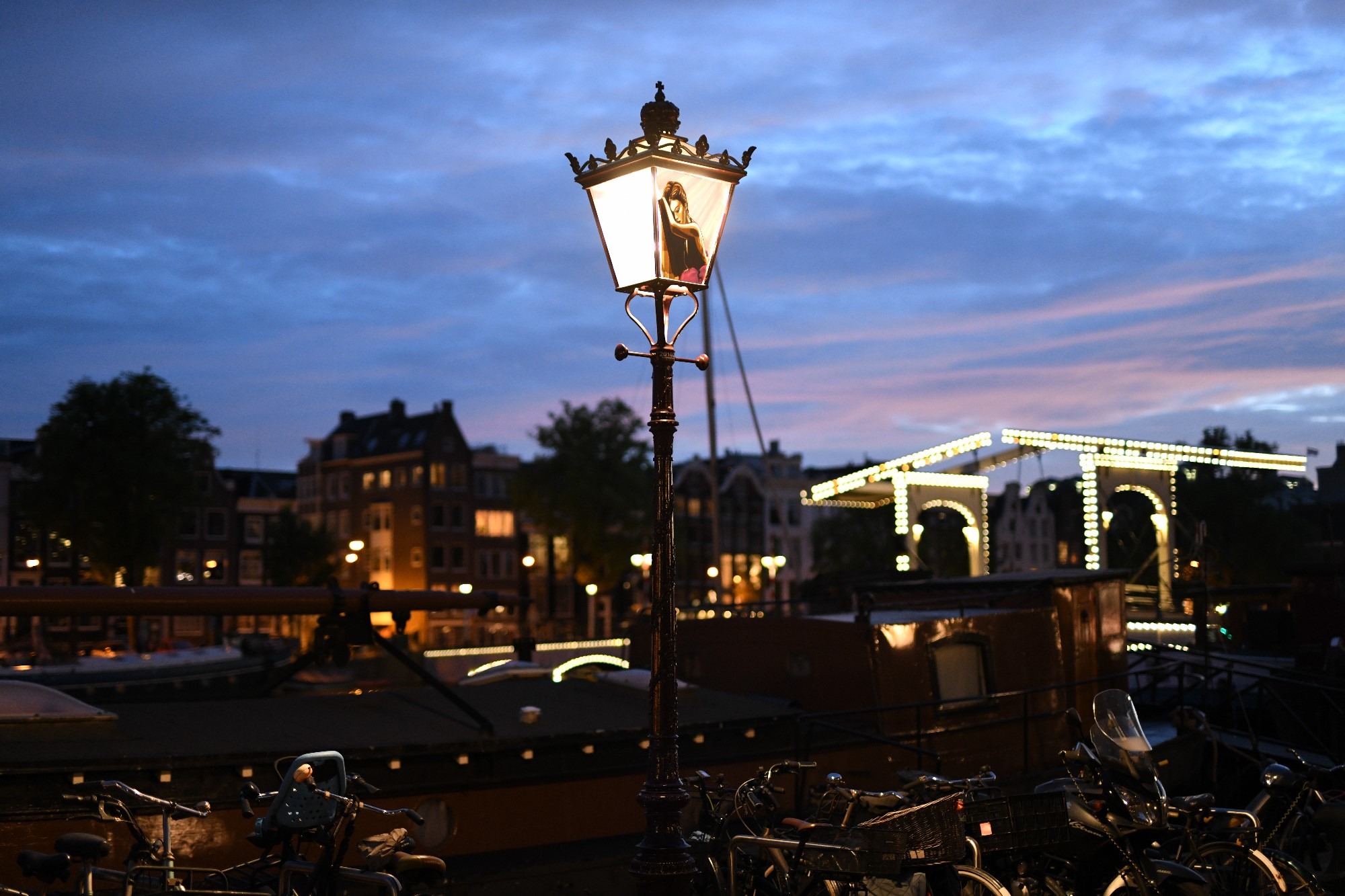
Tape art at a glance
Tape art uses adhesive tape to make the artwork itself. Its history includes collage, public drawing, sculpture and installation, as well as the illuminated packing-tape pictures associated with artists such as Mark Khaisman and Max Zorn.
There is no single origin that accounts for all these practices. Gil J Wolman used tape to lift printed images in the early 1960s. Jaime Davidovich incorporated it into paintings and gallery installations later that decade. The Tape Art collective developed collaborative public drawings from 1989, while other artists explored the material through architectural interventions, cast figures and pictures made from overlapping layers.
The differences matter. A tape mural designed to be removed after an event has a different purpose from a picture built for a collector’s lightbox. A line following a room’s perimeter does something different from a strip that darkens a face. Looking at the individual works makes the history more interesting than treating every use of tape as one style.
A selected chronology
These dates mark documented works, exhibitions and projects. They describe several developments rather than a line of descent from one artist to the next.
- Early 1960s: Gil J Wolman develops Art Scotch, using adhesive tape to transfer fragments of printed matter.
- 1967–1968: Jaime Davidovich introduces commercial tape into his Collage Tape Paintings, then extends it across gallery walls.
- 1989: The Tape Art collective begins in Providence, Rhode Island.
- 1999: Jim Lambie’s ZOBOP uses coloured vinyl tape to follow a room’s outline across its floor.
- 2003: Mark Jenkins begins public interventions in Rio de Janeiro, developing packing-tape casts of objects and figures.
- 2005–2007: Mark Khaisman begins exhibiting packing-tape pictures; Delaware Art Museum acquires a work in 2007.
- 2008–2009: Monika Grzymala presents a spatial drawing at Chinati. Numen/For Use builds Tape Zagreb, and El Bocho completes a tape portrait on Berlin’s Stattbad Wedding facade.
- 2011: Max Zorn’s illuminated street-lamp artworks attract attention in Amsterdam. Tape That is founded in Berlin.
- 2014: Tape Art makes Buffalo Caverns with public participation; visitors enter Numen/For Use’s Tape Paris at Palais de Tokyo.
- 2016: The Tape Art Convention brings different practices together at Neurotitan Gallery in Berlin.
- 2019–2020: Tape That’s Taipei exhibition opens, then receives a Red Dot Best of the Best award for Exhibition Design.
- 2022–2023: MUCA presents Max Zorn’s solo exhibition City Lights in Munich.
Early experiments with adhesive tape
Adhesive tape was already being used within fine art before the public tape drawings that later became familiar as street art. In Gil J Wolman’s Art Scotch, the adhesive lifts parts of printed words and images from their original surface. Those fragments can then be transferred and rearranged. Tape participates in taking an image apart as well as assembling a new one.
Frédéric Acquaviva’s MACBA catalogue essay on Wolman dates the development to 1963. It belongs to the early history of tape as an artistic material, although its transfer process differs considerably from drawing with coloured strips or building a backlit picture.
Jaime Davidovich approached tape through painting. According to Daniel R Quiles’s essay on Davidovich’s monochromes, commercial adhesive tape appeared in the Collage Tape Painting series in 1967. It gradually replaced paint. In 1968, Davidovich was covering gallery walls with tape in Cleveland, extending the work beyond the dimensions of a canvas.
These examples establish two early possibilities: adhesive tape could transfer an existing image, or it could become the visible surface of an artwork. Neither requires a street-art origin. Later artists working outdoors added further purposes and methods to a material that was already being tested in the studio and gallery.
Tape art in public space
Collaborative drawings in Providence and Buffalo
The Tape Art collective traces its beginning to a drawing made in Providence, Rhode Island, on 16 September 1989. Its history records the introduction of low-adhesive blue tape in 1992. Working together on large surfaces became central to the practice, with removal often planned from the outset.
Buffalo Caverns shows how that approach could work as a museum commission in public space. In August 2014, the collective made a green and blue painter’s-tape mural on Buffalo Central Library for the Albright-Knox’s Public Art Initiative, now part of Buffalo AKG Art Museum. Passers-by helped create the drawing and later helped remove it. Its temporary life was part of the project, rather than a failure to preserve a permanent mural.
Architecture, portraits and the street
Australian artist Buff Diss uses masking tape to construct graphic lines and figurative forms across architectural surfaces. A building supplies scale, corners and interruptions that affect the drawing. URBAN NATION documented his participation in its Project M/3 in Berlin in 2014, placing this tape-based practice within an international street-art programme.
In July 2009, El Bocho completed a large tape portrait on the facade of Stattbad Wedding in Berlin. The building’s exterior became the support for a public image. It is another strand of tape’s street history, distinct from the collaborative temporary drawings of the Providence collective.
An audience within the image
At the opening of Ashburton Art Gallery in New Zealand in May 2015, Erica Duthie and Struan Ashby of Tape Art NZ incorporated visitors’ profiles into Furrowed Brow. Blue masking tape and some billboard vinyl formed a temporary mural about the surrounding rural community. Visitors contributed their likenesses to a work being made around them.
These projects involve the public in different ways: through a shared drawing, an encounter on a street, or a contribution to the image. Their choice of tape and surface also differs. Clean removal is a property to establish for a particular project, not something guaranteed by calling it tape art.
Max Zorn: street art in Amsterdam and beyond
Street lighting and the beginnings in Amsterdam
For Max Zorn, the initial question concerned street art at night. He wanted to work with the lights already present in a city. In his 2016 Art Business News interview, he recalled making marker drawings on acrylic glass for street lights, then noticing how a piece of brown tape used to attach a drawing looked against the light.
He experimented by cutting and layering tape on his kitchen window with a sushi knife. The first result, in his account, was ugly and difficult to remove. The process developed through further attempts. By December 2011, La Vanguardia was reporting on the small tape artworks he installed on Amsterdam street lamps.
Repeated questions about the material led him to film the making of an artwork. The video showed each layer being cut and parts peeled away before the completed picture was placed on a street lamp. Its circulation brought enquiries from galleries and people wanting to buy or exhibit the work. Showing the process made the physical object easier to understand.
Stick Together: taking tape art to other cities
Through Stick Together, Max sent handmade artworks to people who chose public lights in their own cities, placed the pictures and sent back photographs. A work’s location was partly determined by the person receiving it. He discussed this exchange at TED@Amsterdam in 2012.
The project extended a studio practice through other people’s choices and local knowledge. It also kept an encounter with the actual artwork central: the picture had to reach a place where light could pass through it and where somebody might notice it. That public project developed alongside the gallery activity associated with Audrey Sykes and Stick Together.

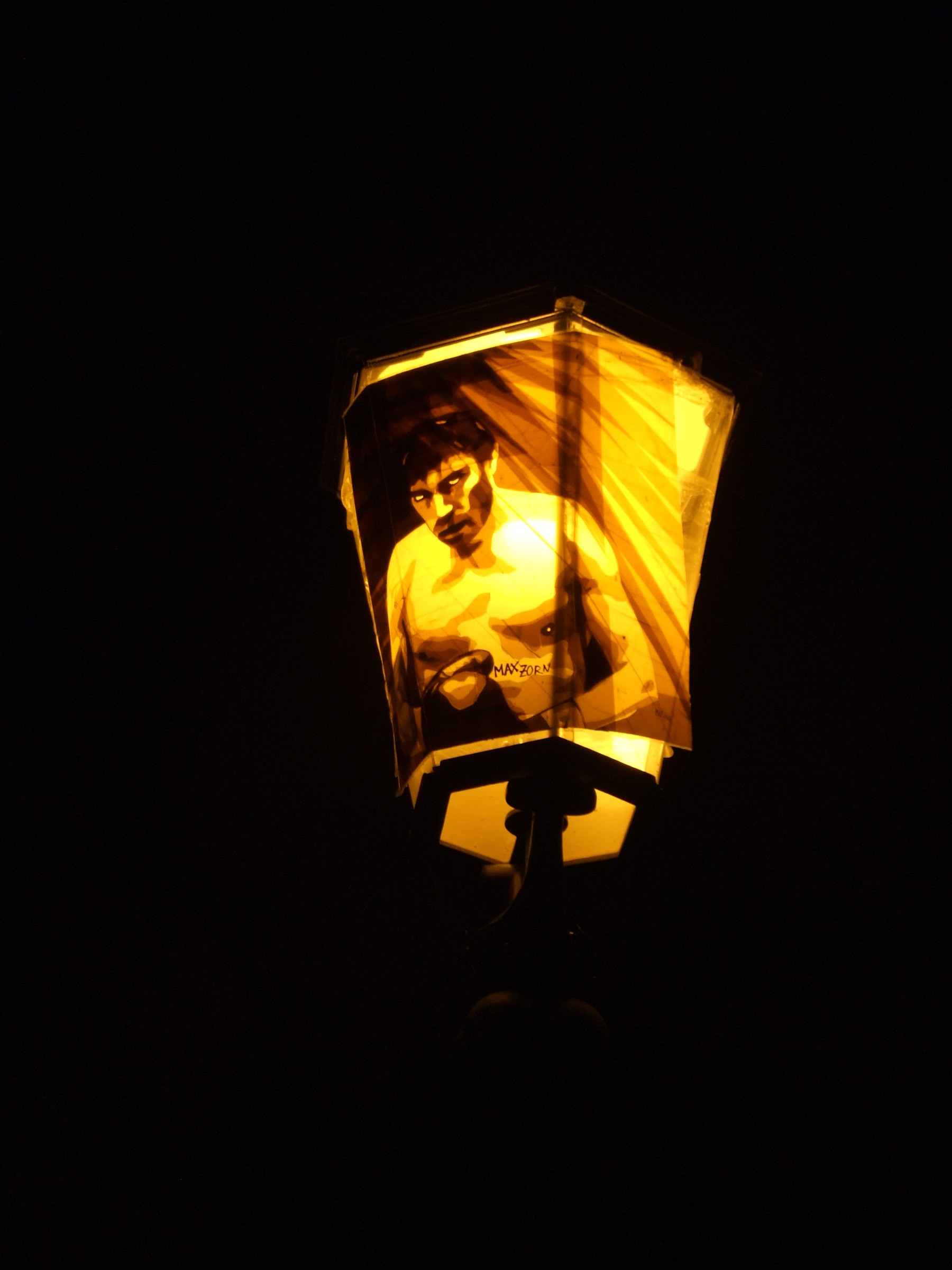
Street art need not occupy a wall. In these pictures, a piece of city infrastructure supplies the light that makes the image visible. The subject can be intimate even when the setting is public: a single face encountered on an ordinary route through the city. Explore Max Zorn’s street art and the Stick Together project.
A figurative language in packing tape
Max cuts into layers of packing tape with a scalpel, adding density where a part of the image needs to become darker. Brown tape gives many early pictures their sepia palette. Coloured tapes have extended the range of later compositions, including the large Miami triptych Fire wrapped in melody. The image remains handmade tape on acrylic glass, illuminated from behind.
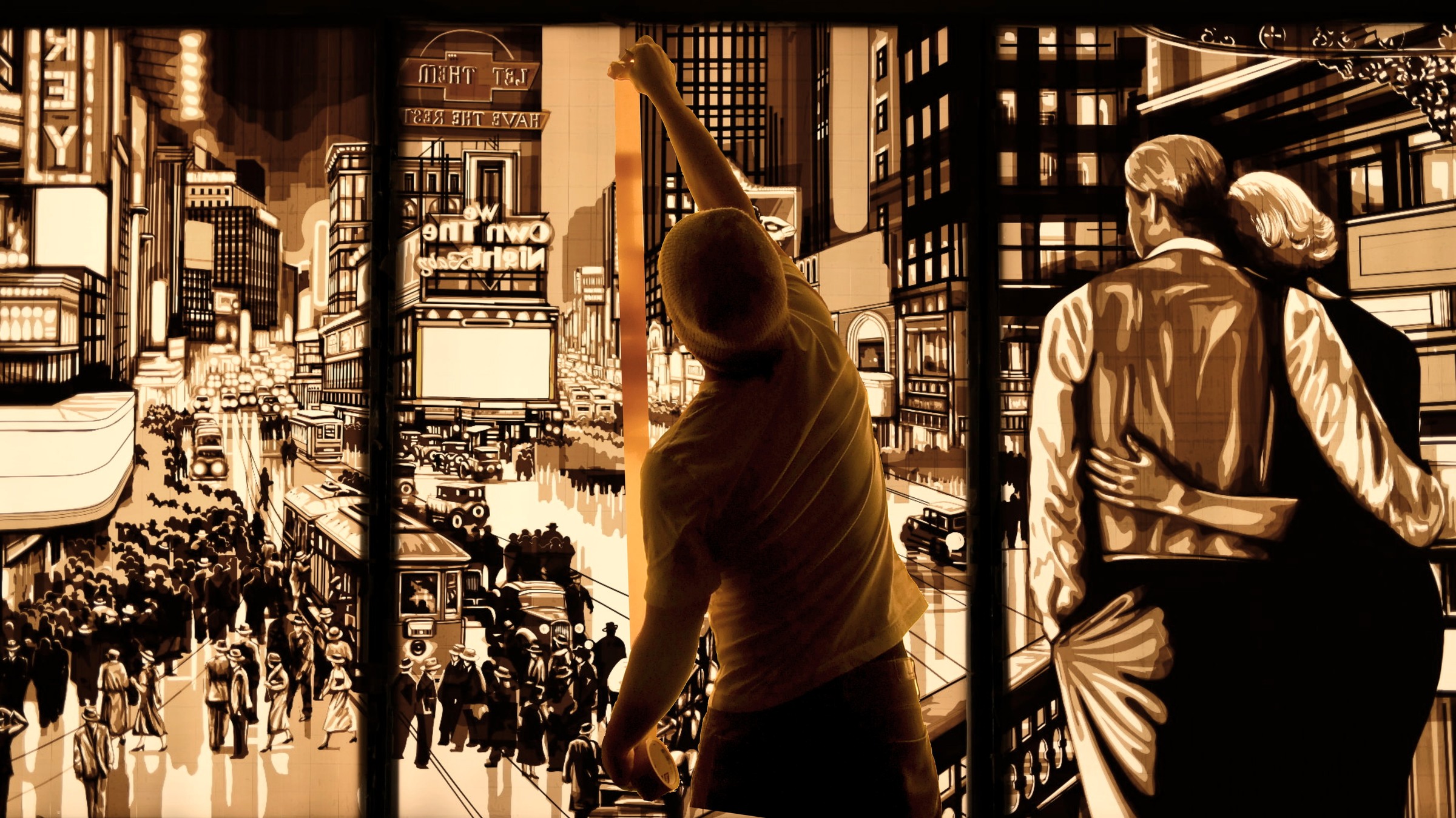
Cars, city interiors and the figures inhabiting them connect the pictures with cinema, but the compositions are constructed rather than tied to a single film or period. In his BBC interview, Max described combining elements from different decades within one scene. Speaking to Deutsche Welle, he named Hemingway, Steinbeck and Salinger among his literary interests, particularly their flawed characters.
The people in these pictures can appear assured or vulnerable without the scene explaining which reading will prevail. Max’s Widewalls interview describes the compositions as fiction and invites viewers to add their own stories. Tape determines how the picture is made; composition and subject give someone a reason to keep looking after the method is understood.
Fairs, demonstrations and museum exhibitions
Live making remained part of Max’s public work as his exhibition career developed. He demonstrated tape art at SXSW in Austin in 2014 and presented Stick Up: The Layers of Tape Art with Audrey Sykes at TEDxTUM in 2015. BBC News, CNN Style, Deutsche Welle, CBS Sunday Morning and NBC Texas Today have each featured the practice; the media archive brings the interviews and demonstrations together.
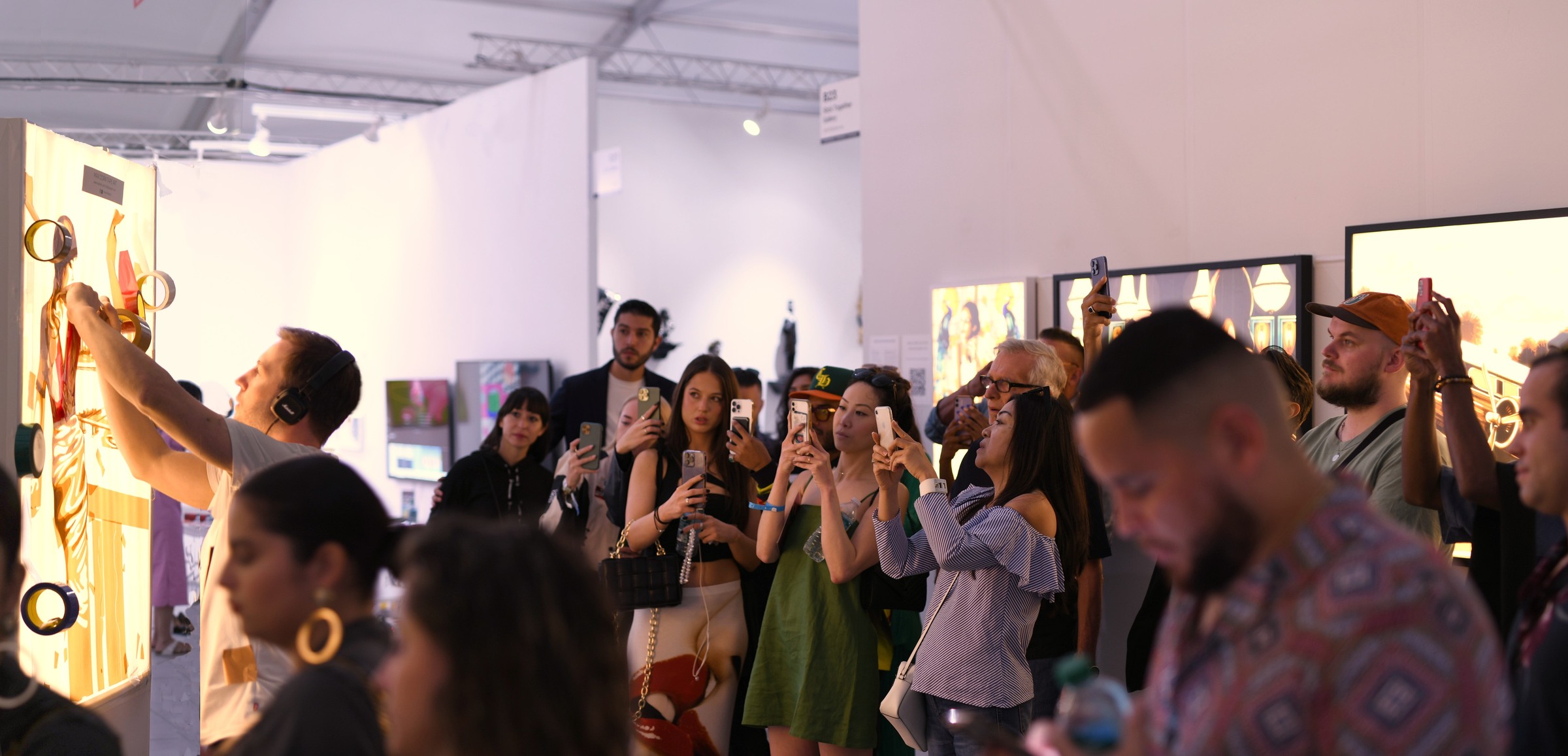
His artworks have appeared at SCOPE Miami Beach, Aqua Art Miami and CONTEXT Art Miami, as well as Moniker in London, District 13 in Paris and Affordable Art Fair in Hong Kong and Singapore. Reviewing Moniker in 2016, Financial Times critic Rachel Spence discussed the film-noir character of the pictures after watching Max work at the fair. The review and transcript place the work within the wider fair.
For the Dutch Resistance Museum, Max made portraits of children who had lived through the Second World War. Children of the War, presented during Amsterdam Light Festival in 2013–2014, included four portraits above the entrance and another in the auditorium. The subject gave the illuminated portrait a particular historical and institutional purpose.
His museum exhibition record also includes My Time, My Town at Amsterdam Museum in 2014 and the group exhibition Reimagined at Cornell Art Museum in Florida in 2015. In Munich, MUCA’s City Lights brought together works from different stages of his career in 2022–2023, including loans from private collections and a work commissioned for the museum.
At Hill-Stead Museum in Connecticut, a tape artwork installed inside a red British telephone box appeared in The Arethusa Collection in 2024–2025. It came from Tony Yurgaitis’s private collection. Across these settings, the same practice has served intimate fictional scenes, public installations and portraits made for a museum’s historical subject.
Explore Max Zorn’s process in detail, or browse the full exhibition archive.
Different materials and approaches
A roll of tape has a width, a backing and an adhesive. Those ordinary details affect what an artist can make. Paper can be torn to leave a soft edge; a smooth film can be cut into a sharp contour. An opaque strip produces a solid mark, while a translucent layer can change the amount of light passing through an image.
Paper, cloth and vinyl
Paper masking tapes are widely used for drawings and temporary installations. Washi tape introduces thin paper in many colours and printed patterns. The mt range made by Kamoi Kakoshi in Japan is semi-transparent and can be torn by hand. Overlapping strips and exposing their edges offer choices closer to collage than to a continuous painted surface.
Cloth-backed duct tape has a reinforcing fabric layer. The construction described in 3M’s cloth duct-tape documentation differs from the paper backing of washi tape or the plastic film of vinyl tape. Artists can cut or tear it into shapes. Selfmadecrew’s ArtHoover, made for the 2016 Tape Art Convention in Berlin, is a documented mural made entirely from duct tape.
Vinyl tapes provide another range of surfaces and colours. Some conform to curves; some are translucent. Product construction matters more than assuming all plastic tape behaves alike. Terms such as masking or electrical describe an intended use, while paper, cloth and vinyl describe backing materials. The categories overlap.
Tape as a drawn mark
In Benjamin Murphy’s Gilded Chaos at BEERS London in 2016, black electrical tape formed figurative drawings and an installation across the gallery. Tape could carry detailed imagery as well as broad graphic bands. Italian artist NO CURVES makes a different formal choice, building his tape drawings around angles and straight lines.
Packing tape and transmitted light
Translucent packing tape allows an image to be made through variations in density. Each additional layer lets less light pass through. On a clear acrylic support, a small number of layers creates a lighter tone; repeated overlaps make an area darker. The artist can build the modelling of a face or an interior through those differences.
Mark Khaisman began exhibiting packing-tape work in 2005. His account of the process describes applying brown tape to a backlit acrylic panel, adding, removing and reworking strips as the image develops. The remaining strips and overlaps are part of the image’s texture. His subjects include familiar figures and images drawn from film and visual culture.
Delaware Art Museum’s No darling, thank heavens, I can’t remember a wife, dated 2006, records the material directly: packaging tape on Plexiglas with a lightbox. The museum acquired it in 2007. At the Memorial Art Gallery’s Extreme Materials 2 in 2011–2012, Khaisman’s Lydmila appeared in a steel lightbox. These are specific examples of the illuminated picture entering museum exhibitions and collections.
From a line on a surface to a work in space
Jim Lambie: following the room
Jim Lambie’s ZOBOP of 1999 begins at the perimeter of a room. Repeated bands of coloured vinyl tape follow its outline across the floor, incorporating the room’s irregularities into the arrangement. The installation adapts to the architecture in which it is shown.
The National Galleries of Scotland acquired this work in 2001. MoMA holds a separate ZOBOP from 2006, and Vancouver Art Gallery presented Zobop (Colour-Chrome) across its Rotunda floor and stairs in 2025–2026. These installations give the viewer a colour field to walk across and an altered view of the room’s geometry.
Monika Grzymala: drawing beyond the wall
Monika Grzymala uses tape in drawings that extend through space. Her 2008 installation at the Chinati Foundation’s Locker Plant brought tape together with paint and dead trees. The work occupied the room in three dimensions, responding to the site rather than treating it as a neutral container.
Here the line has a physical presence between surfaces. Its position, tension and connection to other materials become part of what the visitor sees. Tape can operate as drawing while taking on some of the spatial conditions of sculpture.
Mark Jenkins: casting a figure
Mark Jenkins developed a sculptural use for packing tape through casts of objects and human figures. His public interventions began in Rio de Janeiro in 2003. With Sandra Fernandez, he has worked as Glazed Paradise since 2005.
The Le Havre public-art programme describes his moulded figures as constructions of plastic film and adhesive tape, dressed and placed in streets or interiors. Seen at a distance, a figure may be read first as a person. The work’s position in an ordinary setting becomes as consequential as the material from which it was made.
Numen/For Use: entering the tape structure
For Tape Zagreb in 2009, Numen/For Use wrapped tape around cardboard columns and around earlier layers. Its later installation at Vienna’s Odeon in 2010 developed stretched main lines into a membrane through diagonal wrapping and repeated layering. The membrane enclosed a volume that visitors could enter.
At Palais de Tokyo in 2014, Tape Paris occupied the entrance hall of the Inside exhibition. A visitor experienced the artwork from within its translucent enclosure. The collective traces the idea to a stage-design concept in which dancers would stretch tape between pillars, leaving their movements recorded in a structure.
Optical space and a particular viewpoint
Darel Carey arranges repeated lines across walls, floors and ceilings so that their spacing produces apparent depth. Torrance Art Museum has documented successive installations in which flat surfaces appear to change shape as the viewer moves. The tape remains on the surface; the apparent volume is produced by the arrangement of lines.
A related concern with viewpoint appears in Stefan Busch’s Hole for the MT Art Project in Japan in 2021. Horizontal tape lines inside a former seaside hospital in Ushimado align into an apparent circle from a particular position. The room’s corners and changes of plane become part of the image. This dependence on a chosen viewing position is known as anamorphosis.
Such works offer different encounters with space. Lambie follows the room, Grzymala extends drawing through it, and Numen/For Use constructs an enclosure inside it. In an optical installation, the viewer’s movement can change the apparent image without changing the tape itself.
Exhibitions, collectives and collaboration
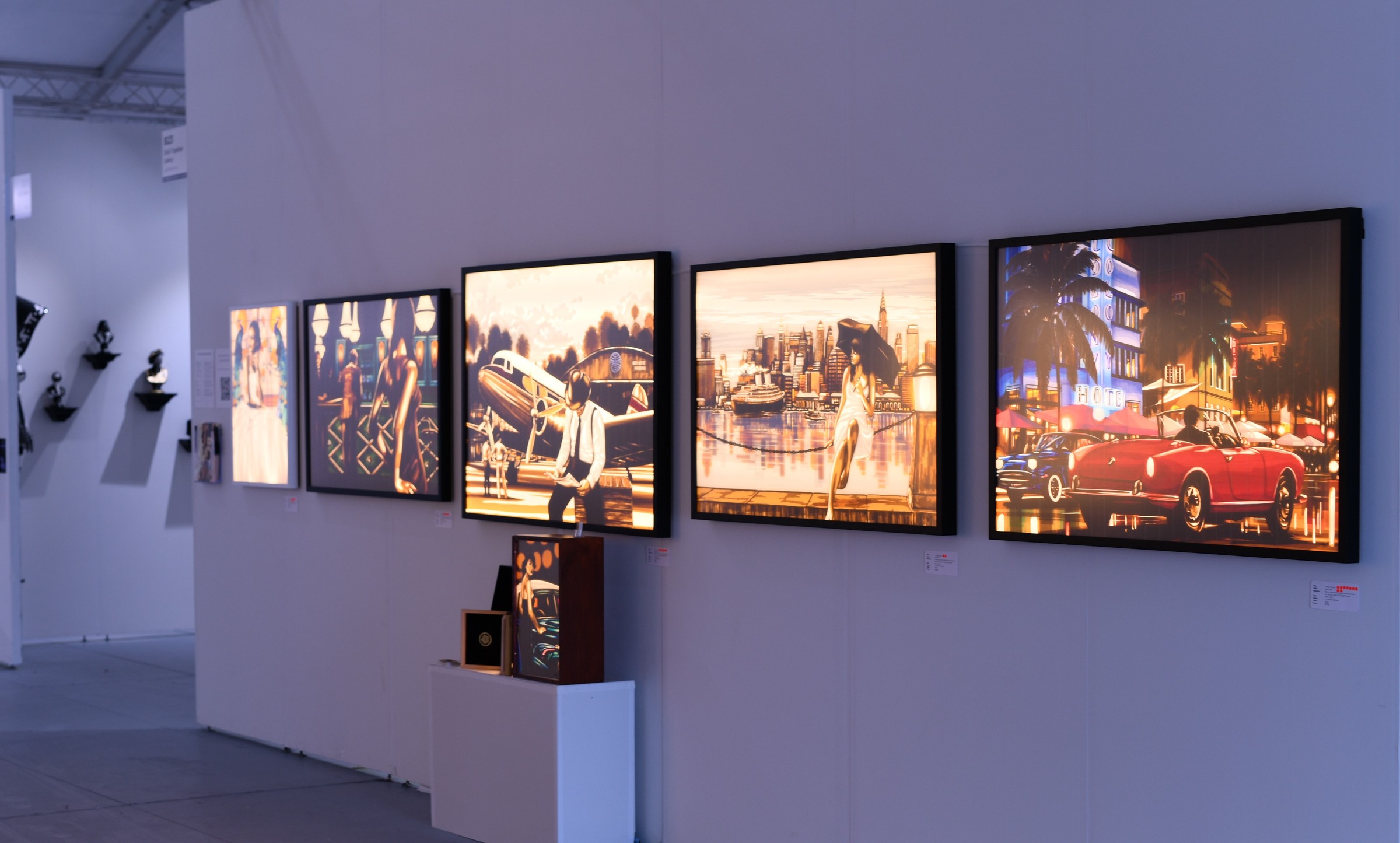
Founded in Berlin in 2011, Tape That developed murals, facade works and room installations alongside workshops and collaborative projects. Its practice helped create occasions on which audiences could see different uses of tape together.
The Tape Art Convention at Neurotitan Gallery in 2016 brought together artists including Mark Khaisman, Max Zorn, Buff Diss, Benjamin Murphy and Tape That. A packing-tape picture, a figurative electrical-tape drawing and a duct-tape mural could be encountered within the same exhibition. The shared material provided the connection; the artworks retained their different methods and intentions.
Tape That’s exhibition at Songshan Cultural and Creative Park in Taipei opened in July 2019. It used rooms organised around illusion, reflection and changes of viewpoint, combining tape with sound and light. Visitors could also contribute tape to large letterforms. The exhibition received a Red Dot Best of the Best award for Exhibition Design in 2020.
Digital projection adds another technique. In a collaboration documented by TAPE OVER and ONDÉ at Betahaus Berlin, the taped composition and projection mapping were developed during the same live performance. Projected imagery changes what appears on the tape surface. In illuminated packing-tape pictures, by contrast, light passes through the layers that form the image.
Tape art in museum collections
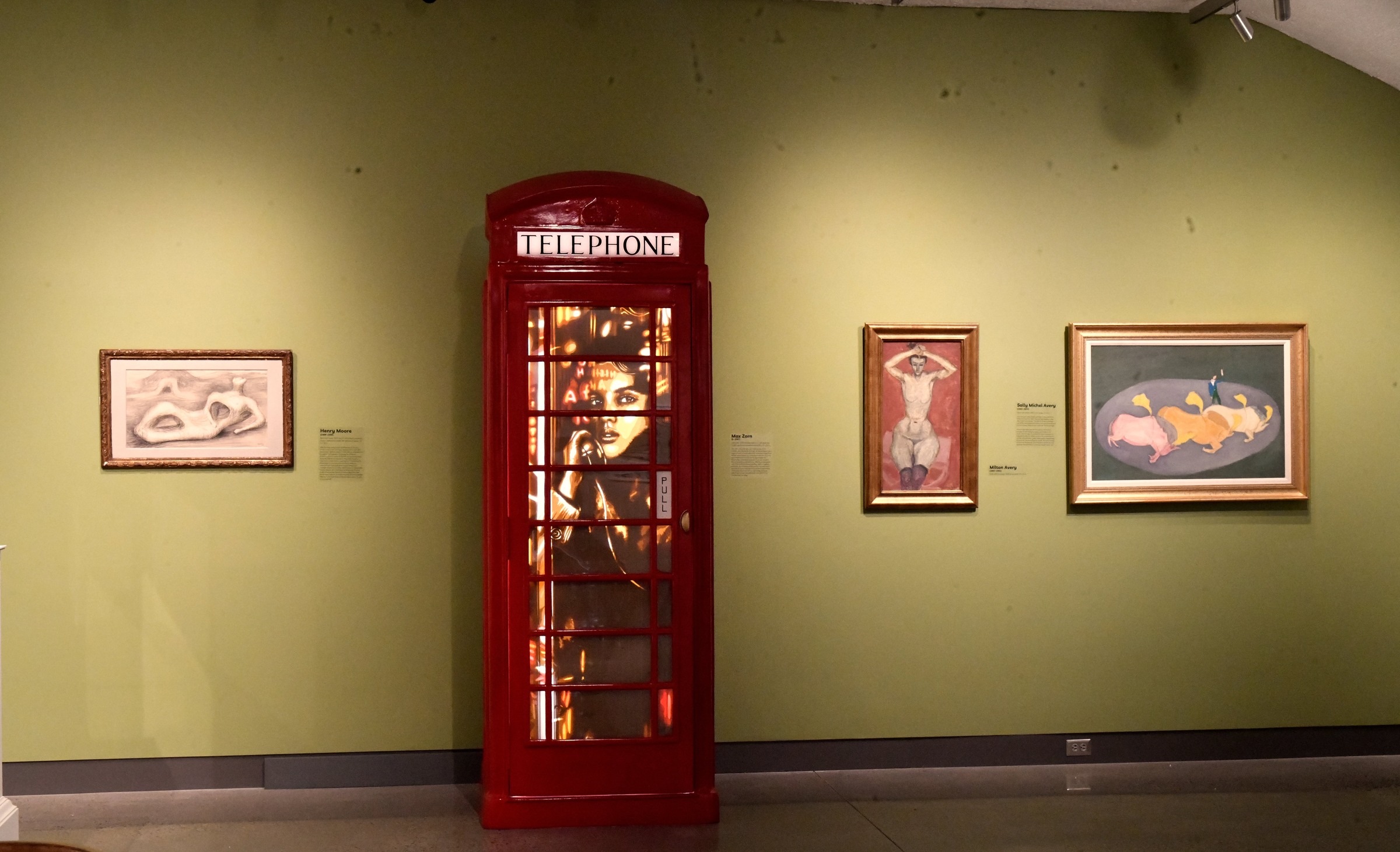
Museum records show that tape-based artworks have entered collections in quite different forms. Lambie’s floor installations are represented by specific works at the National Galleries of Scotland and MoMA. Khaisman’s packing-tape picture entered Delaware Art Museum in 2007. Ripley’s Believe It or Not! acquired a Marilyn Monroe tape artwork by Max Zorn.
The way each work is encountered depends on its construction. A floor installation is arranged in relation to a room. A lightbox picture brings its support and illumination with it. A public mural may exist for a specified period and survive afterwards through photographs and project documentation. The material alone does not determine whether an artwork is portable, temporary or intended for a collection.
Exhibitions have also placed tape alongside other materials. Khaisman’s inclusion in Extreme Materials 2 and Max’s participation in Reimagined offered contexts in which viewers could consider what artists make from familiar products. A visitor does not need to collect tape art as a category to be interested in one of these pictures, sculptures or installations.
Temporary works and lasting objects
The planned removal of Buffalo Caverns belonged to its public event. For a collector’s illuminated artwork, continued display is part of the intention. Both uses have a place in the medium’s history; their materials and methods should be assessed in relation to that purpose.
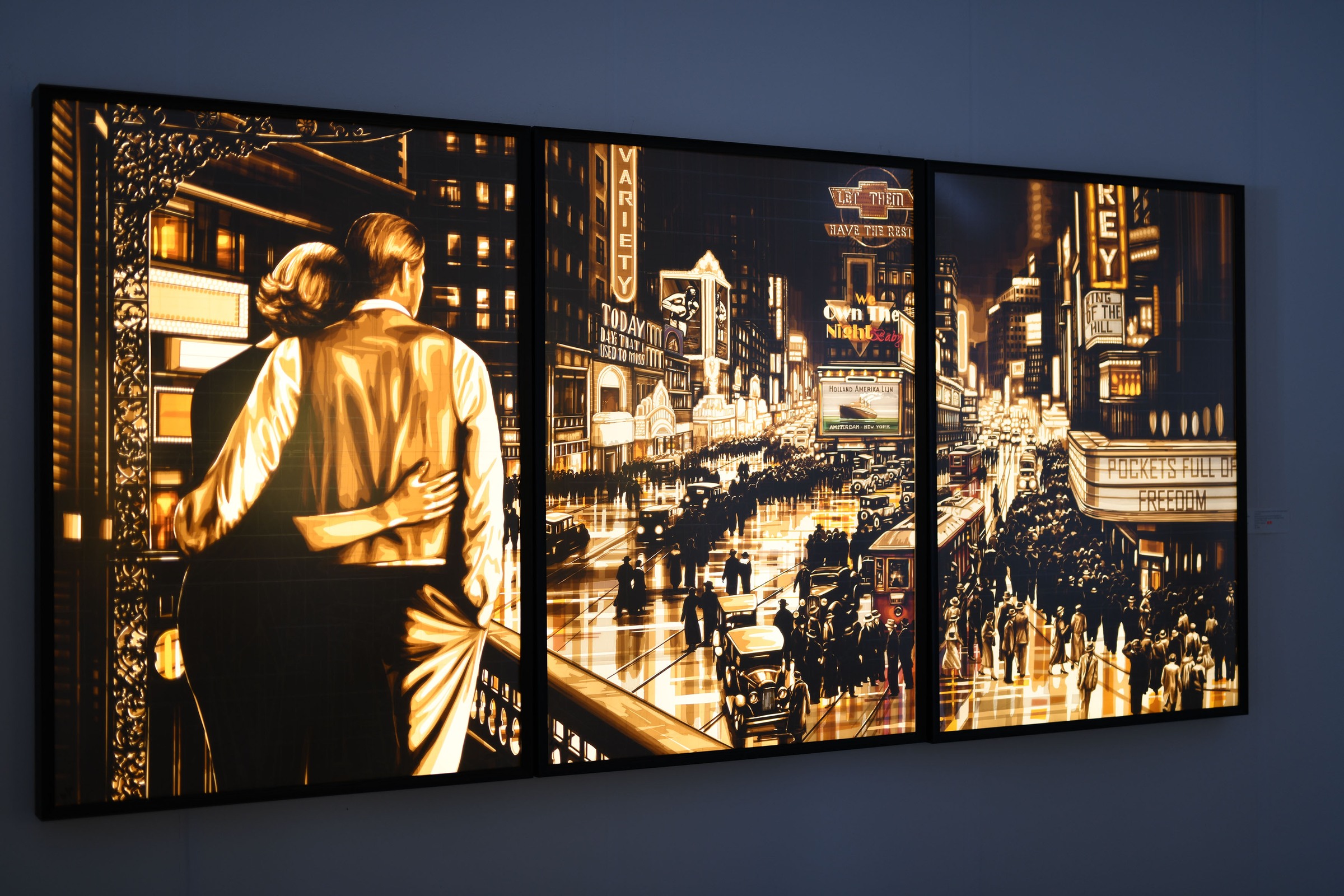
Tape has an everyday familiarity that makes the process easy to approach. A viewer can recognise the roll and still be surprised by what it produces. That familiarity does not give every tape artwork the same meaning. Khaisman’s use of established images, Max’s fictional scenes and a community mural ask different things of the material and of their audiences.
Conservation likewise concerns the particular object. Tape backings, adhesives, supports and lighting systems vary. Display conditions affect them. Max’s collector artworks pair hand-cut tape on acrylic glass with an illuminated frame for indoor display; the care and longevity guide explains their handling and maintenance. His Similar Originals page explains how individually handmade artworks within a limited series are made and documented.
For a broader introduction to the medium and its contemporary forms, return to the Tape Art guide. To see how Max develops an image from tape, continue to his packing-tape technique.
Sources and further reading
This history is published by Max Zorn’s studio. It draws on museum collection records, exhibition documentation, artists’ accounts and interviews. Source links appear beside the relevant works and events.
- Early work: Frédéric Acquaviva, Wolman in the Open, MACBA; Daniel R Quiles, Jaime Davidovich’s Generative Monochromes.
- Public drawing: Tape Art’s project history; Buffalo AKG’s Buffalo Caverns record; Ashburton Art Gallery’s Tape Art NZ account.
- Artists and materials: Mark Khaisman’s 2012 process interview; Numen/For Use’s Tape project archive; Stefan Busch’s Tape Art Convention archive.
- Collection records: National Galleries of Scotland; MoMA; Delaware Art Museum.
- Max Zorn: Art Business News interview; MUCA’s City Lights; Amsterdam Light Festival; Hill-Stead Museum’s Arethusa Collection.